

Forty states are projected to see a decline in public PK-12 enrollment through at least 2031. Some like Nebraska, Arizona, Oklahoma, and Texas will likely contract less than 1%, while others such as Oregon, California, New York, and Louisiana are expected to experience double digit declines.
Driving this contraction of the student population, not just among public schools, is an average birthrate that has lowered from 69.5 births per 1,000 women in 2007 to 53.8 in 2024. The total number of live births in the United States shrank from 4.3 million to 3.6 million over the same period.
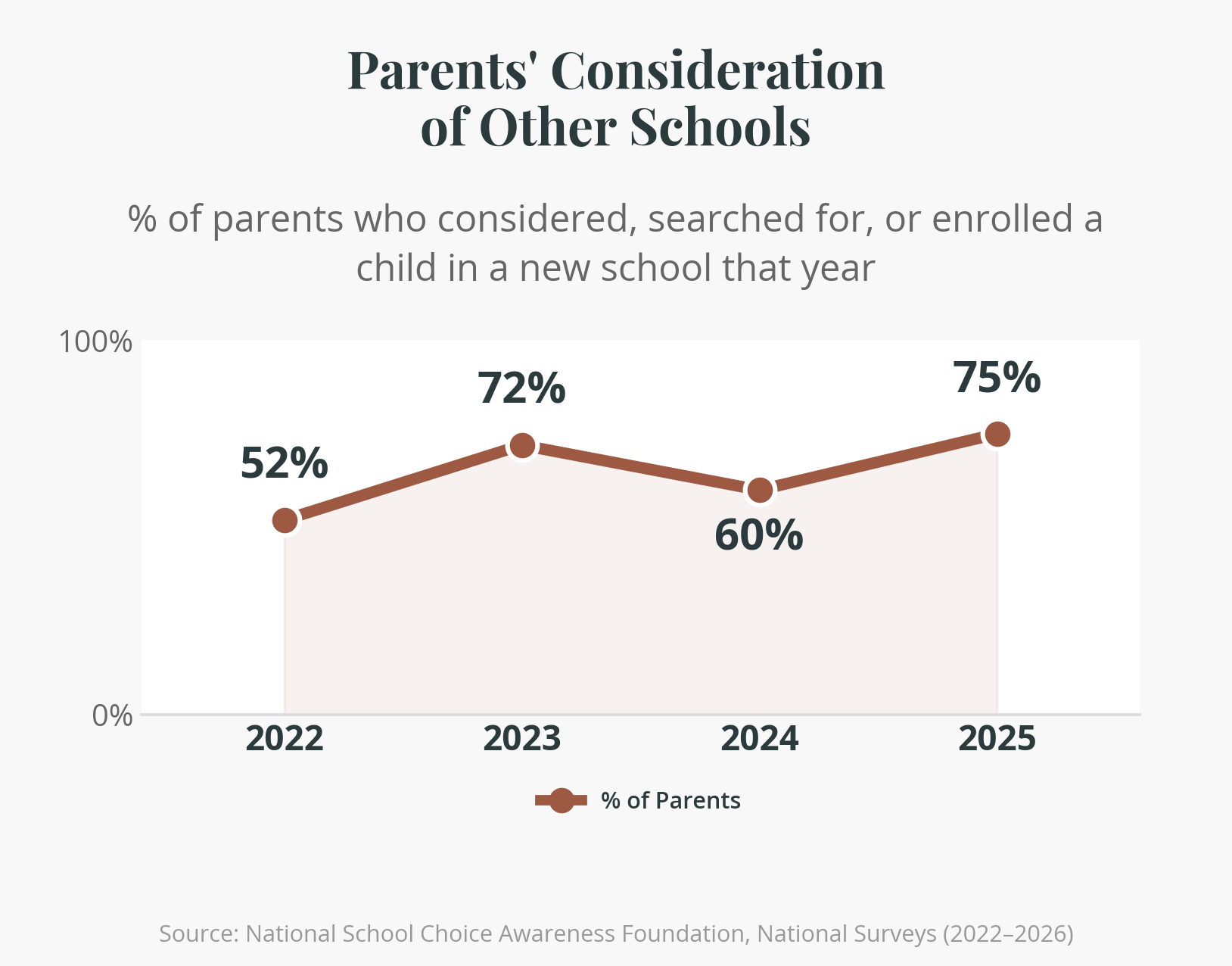
Beyond the demographic shift, another force shaping the enrollment picture is the rapid proliferation of school choice. A 2026 survey suggests that 75% of families considered, searched for, or enrolled a child in a new school the previous year. No doubt this is largely due to the expansion of charter school networks, non-traditional school models, and education savings accounts (ESAs) that now serve families in 18 states.
A shrinking pool of students, multiplying options, and generations of parents that have adopted a choice mentality has fundamentally changed what it takes for a school to succeed in a highly competitive environment.
Ask most school leaders what makes their school stand apart, and the answer is usually pulled from a familiar list: caring teachers, strong academics, a great community, individualized attention and so on. Every item on that list may be true, but every item is also what the other school down the road likely says about itself.
When a school offers a value proposition that could describe almost any competitor in the market, it is no longer of any use in attracting families. Instead, parents default to whatever is easiest to compare: price, proximity, or word of mouth reputation. None of these are within a school’s control. A school that cannot distinguish itself in its own words has effectively left the parent’s decision to chance.
What Distinctive Schools Do Differently
Three points tend to separate schools that hold a distinct competitive advantage in a tightening market from those that do not.
- They have made a real choice about who they serve best, rather than trying to be all things to all people. A school that appeals to everyone rarely becomes the clear first choice for anyone.
- Their value proposition is checked against evidence, not opinion. It reflects what the institution is genuinely equipped to deliver, what families are seeking, and what they cannot easily get elsewhere.
- Their differentiators are strategic and durable. They are not something a motivated competitor or new entrant could copy within a year or two.
None of this feels urgent until it suddenly is. A school that has existed for a generation can lose their advantage within a few enrollment cycles once a new competitor opens, a policy shifts, or family preferences move in a different direction. As the education market continues to evolve, thriving schools are going to be those that leverage their institutional strengths to meet real market demand but in a way that truly differentiates them from competitors.
Arcadia’s market and competitive analyses help school leaders define a value proposition and a differentiation strategy so families can clearly understand why they should choose your school. Contact us to learn more.
Sources:
- National Center for Education Statistics
- CDC/National Center for Health Statistics
- National School Choice Awareness Foundation
- EdChoice, Funded Eligibility Rankings (2026)